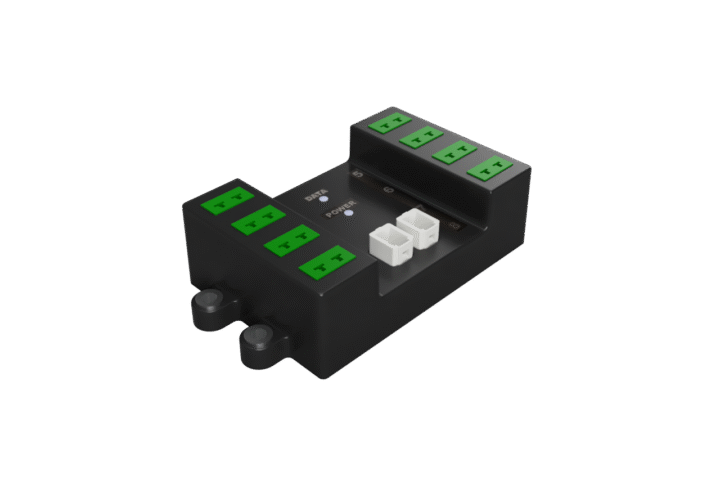
Temperature measurement forms the foundation of industrial process control, equipment monitoring and research applications across manufacturing, energy production and materials science. Thermocouples provide reliable temperature sensing from cryogenic conditions through extreme heat exceeding 1,800°C, making them indispensable across diverse applications. However, converting thermocouple signals into accurate digital data whilst maintaining electrical isolation presents significant technical challenges. The 8-Channel Isolated Thermocouple Module from Metis Engineering addresses these requirements through precision measurement hardware delivering exceptional accuracy across extreme temperature ranges with comprehensive electrical isolation protecting sensitive measurement circuits.
Thermocouple Fundamentals and Application Range
Thermocouples generate small voltages proportional to temperature differences between measurement and reference junctions. This simple, passive operating principle provides inherent reliability without requiring external power at the sensing point. The robust construction of thermocouple probes withstands mechanical stress, vibration and corrosive environments that would destroy alternative temperature sensors.
Different thermocouple types utilise varying metal combinations optimised for specific temperature ranges and accuracy requirements. Type K thermocouples serve general-purpose applications from -200°C to +1,260°C. Type J provides good performance at lower temperatures. Type T suits cryogenic applications. Type R, S and B thermocouples withstand extreme heat exceeding 1,600°C essential for furnace monitoring and materials processing.
The Metis Engineering 8-Channel Isolated Thermocouple Module supports all common thermocouple types through software-configurable input conditioning. This flexibility enables mixed thermocouple populations within single systems, accommodating diverse measurement requirements without requiring multiple interface modules.
Electrical Isolation Requirements
Industrial environments present significant electrical noise, ground potential differences and transient voltages threatening measurement accuracy and equipment safety. Thermocouples installed on machinery, furnaces or process equipment may experience ground potentials hundreds of volts different from data acquisition systems, creating ground loops that introduce measurement errors and potentially damage interface electronics.
Electrical isolation breaks galvanic connections between thermocouple inputs and data acquisition systems, eliminating ground loops whilst protecting expensive equipment from electrical transients. Each channel requires independent isolation enabling measurement of thermocouples at different ground potentials simultaneously.
The 8-Channel Isolated Thermocouple Module provides channel-to-channel isolation and channel-to-system isolation ensuring measurement independence regardless of ground potential differences. This comprehensive isolation approach enables accurate multi-point temperature measurement in the most electrically challenging industrial environments.
Precision Cold Junction Compensation
Accurate thermocouple measurement requires precise knowledge of reference junction temperature for cold junction compensation calculations. Traditional approaches locate a temperature sensor near terminal blocks where thermocouples connect, measuring ambient temperature as a proxy for reference junction temperature.
This approximation introduces errors when thermal gradients exist between connection terminals and reference temperature sensors, or when self-heating from adjacent electronics affects terminal temperature. High-accuracy applications require more sophisticated cold junction compensation.
The Metis Engineering module implements per-channel cold junction compensation with precision temperature measurement at each thermocouple connection point. This approach eliminates thermal gradient errors, improving absolute accuracy particularly during transient conditions when system temperatures change.
Measurement Resolution and Accuracy Specifications
Temperature measurement quality depends on both analogue front-end design and analogue-to-digital converter resolution. High-resolution ADCs capture small voltage changes enabling fine temperature discrimination, whilst low-noise analogue design ensures resolution translates into actual measurement accuracy rather than digitised noise.
The 8-Channel Isolated Thermocouple Module employs 24-bit sigma-delta ADCs providing exceptional resolution enabling temperature measurements with precision to 0.1°C or better depending on thermocouple type. The high resolution proves particularly valuable in applications measuring small temperature differences or tracking gradual temperature trends.
Careful PCB layout, component selection and shielding design minimise noise pickup ensuring the measurement system achieves accuracy approaching thermocouple fundamental limits rather than being dominated by interface electronics noise.
Temperature Range Coverage and Extreme Environment Applications
Cryogenic research, liquefied gas handling and superconductor development require accurate temperature measurement below -200°C. High-temperature furnaces, materials processing and combustion research demand measurements exceeding 1,600°C. Few measurement systems accommodate both extremes within single platforms.
The 8-Channel Isolated Thermocouple Module provides accurate measurement from -200°C through +1,800°C depending on thermocouple type selection. This exceptional range enables diverse applications using common interface hardware, reducing inventory complexity and training requirements.
Materials testing applications often require characterising samples across broad temperature ranges. The wide measurement capability eliminates the need to switch instrumentation as test conditions change, improving data consistency and reducing experimental complexity.
Multi-Channel Simultaneous Sampling
Some applications require simultaneous temperature measurement across multiple points with precise time alignment. Furnace thermal mapping, transient thermal response characterisation and multi-point control applications all demand coordinated measurement rather than sequential channel scanning.
The module architecture supports simultaneous sampling across all channels ensuring temporally aligned data essential for thermal gradient calculation and transient analysis. This capability proves particularly valuable in research applications characterising rapid thermal events where time-skewed measurements would compromise analysis quality.
Control applications benefit from simultaneous measurement enabling more sophisticated control algorithms accounting for spatial temperature distributions rather than simple single-point control. This approach improves process quality whilst potentially enabling higher throughput or energy efficiency.
CAN Bus Integration for Industrial Control Systems
Modern industrial facilities employ distributed control systems managing complex processes across expansive plants. Integration of measurement instruments into these control architectures requires communication protocols compatible with industrial automation standards.
The module’s CAN bus interface provides this connectivity, enabling direct integration into control systems without requiring protocol conversion or gateway devices. Temperature data transmits using standard CAN messaging accessible to programmable logic controllers, supervisory control systems and data acquisition platforms.
CAN’s noise immunity proves particularly valuable in industrial environments where electromagnetic interference from motors, drives and power electronics challenges less robust communication methods. The differential signalling and built-in error detection ensure reliable data transmission despite electrically hostile conditions.
Configurable Channel Assignment and Scaling
Different applications require varying thermocouple types, temperature ranges and engineering units. Flexible interface modules must accommodate these diverse requirements without requiring hardware modifications or variant products for each application.
Software configuration tools enable assignment of thermocouple types to individual channels, selection of temperature units including Celsius, Fahrenheit or Kelvin, and specification of scaling factors for custom display requirements. This flexibility simplifies deployment across diverse applications whilst maintaining single product inventory.
Configuration data stores in non-volatile memory ensuring settings persist through power cycles. This approach eliminates reconfiguration requirements during routine maintenance or equipment power-downs.
Furnace and Thermal Processing Applications
High-temperature furnaces used in ceramics, metallurgy and materials processing require precise temperature control ensuring product quality whilst avoiding equipment damage from thermal excursions. Multi-point temperature measurement provides insights into thermal uniformity, heating element performance and insulation effectiveness.
The 8-Channel Isolated Thermocouple Module enables comprehensive furnace instrumentation with sufficient channels monitoring multiple zones, heating elements and product locations. The extreme temperature capability accommodates both process monitoring and safety shutdown thermocouples operating at maximum furnace temperatures.
Data logging capabilities support process documentation for quality management systems whilst enabling performance optimisation through detailed thermal analysis. The long-term trending identifies gradual degradation of heating elements or insulation guiding preventive maintenance.
Cryogenic Research and Liquefied Gas Handling
Research involving liquid nitrogen, liquid helium or other cryogenic fluids requires accurate temperature measurement at extreme low temperatures. Storage facilities, transport equipment and experimental apparatus all need monitoring ensuring proper thermal management and detecting developing issues.
Type T and E thermocouples provide good performance at cryogenic temperatures, whilst the interface module’s wide temperature range accommodates measurements from ambient conditions through deep cryogenic levels within single installations. This capability proves valuable in applications involving controlled cooling or warming cycles.
The electrical isolation protects interface electronics from potential damage during cryogenic system anomalies whilst enabling measurement of equipment at significantly different temperatures and electrical potentials simultaneously.
Battery Thermal Management Development
Electric vehicle battery pack thermal management represents a critical design challenge balancing cell temperature control against system complexity and parasitic losses. Development testing requires detailed temperature mapping across cell arrays, cooling system performance validation and control algorithm optimisation.
Multi-point thermocouple measurement provides the granular temperature data essential for understanding thermal performance. The 8-channel capability accommodates sufficient measurement points characterising cell temperatures, coolant temperatures and ambient conditions without requiring multiple interface modules.
The CAN integration enables direct data transmission to vehicle development networks where battery management systems, cooling system controllers and data acquisition systems all communicate. This integrated approach simplifies test system deployment and data correlation.
Automotive Exhaust and Emissions Testing
Exhaust system development and emissions testing measure temperatures from engine-out conditions exceeding 900°C through catalytic converter operation and downstream monitoring. These measurements guide thermal management design, catalyst formulation and control strategy development.
Type K thermocouples provide suitable accuracy across these temperature ranges whilst the electrical isolation addresses ground potential differences between exhaust system components and vehicle chassis. The isolation also protects interface electronics from starter motor transients and other electrical events typical of vehicle testing.
Fast response times enabled by high-resolution measurement capture transient events during engine start, acceleration and mode changes. This capability supports detailed analysis of thermal behaviour under dynamic operating conditions.
Research and Laboratory Applications
University research, national laboratories and industrial R&D facilities conduct diverse experiments requiring temperature measurement across broad ranges. Equipment commonality across experiments simplifies procurement, training and support whilst the flexibility to accommodate different thermocouple types and measurement ranges enables varied applications.
The 8-channel module provides an excellent balance between channel count, performance and cost for laboratory applications. Multiple modules can support experiments requiring extensive instrumentation whilst individual modules serve smaller-scale testing.
Integration with data acquisition software supporting CAN communication enables automated data collection, real-time monitoring and post-experiment analysis. The digital communication eliminates analogue signal degradation over long cable runs common in laboratory installations.
Power Generation and Energy Systems
Power plants, whether conventional fossil fuel or renewable energy installations, require extensive temperature monitoring ensuring efficient operation and preventing equipment damage. Boilers, turbines, generators and balance-of-plant equipment all incorporate multiple temperature measurement points.
The harsh electrical environments typical of generating facilities with large motors, generators and power electronics benefit from comprehensive electrical isolation. The module’s industrial-grade construction withstands these conditions whilst maintaining measurement accuracy.
Remote monitoring of geographically distributed renewable energy installations benefits from CAN communication enabling integration with existing control and telemetry infrastructure. The digital communication supports long transmission distances using fibre optic CAN extenders or wireless CAN bridges.
Aerospace Testing Applications
Aircraft and spacecraft component testing subjects parts to extreme thermal environments validating performance across operational temperature ranges. Thermal vacuum testing, re-entry simulation and propulsion development all require accurate multi-point temperature measurement.
The wide temperature range capability accommodates measurements from cryogenic fuel system testing through high-temperature exhaust and thermal protection system validation within common instrumentation. This reduces test facility equipment inventory whilst ensuring consistent measurement approaches across test programmes.
Space qualification requirements demand proven reliability and robust construction. Whilst the module itself may not be suitable for flight, it provides ground test capabilities supporting aerospace development programmes.
Installation and Integration Considerations
Successful thermocouple system implementation requires attention to installation details significantly influencing measurement quality. Proper thermocouple selection, installation location, extension wire specification and shield grounding all impact accuracy.
Metis Engineering provides comprehensive technical documentation including installation guidelines, grounding recommendations and calibration procedures supporting successful deployment. Technical support throughout the integration process ensures optimal system performance.
The module’s compact form factor and DIN-rail mounting capability simplifies installation in industrial control cabinets, laboratory instrument racks or mobile test installations. Standard automotive-grade connectors ensure reliable electrical connections whilst the robust construction withstands industrial environments.
Calibration and Traceability
Measurement accuracy depends on both instrument performance and periodic calibration ensuring continued conformance to specifications. Traceable calibration to national standards provides confidence in measurement quality supporting quality management systems and regulatory compliance.
The module design enables field calibration without requiring return to factory, minimising downtime for routine calibration. Comprehensive calibration documentation supports ISO 9001 quality management systems and other standards requiring measurement traceability.
Future-Proofing Industrial Measurement
Industrial temperature measurement requirements evolve driven by process optimisation, regulatory changes and technology advancement. Measurement infrastructure must adapt without requiring frequent replacement.
The 8-Channel Isolated Thermocouple Module’s flexibility through software configuration and CAN communication provides the adaptability essential for evolving applications. As new requirements emerge, the system accommodates changes through configuration rather than hardware replacement.
Conclusion: Precision Temperature Measurement for Demanding Applications
Accurate multi-channel thermocouple measurement across extreme temperature ranges with comprehensive electrical isolation enables diverse industrial applications from materials processing through research and energy systems. The 8-Channel Isolated Thermocouple Module from Metis Engineering delivers the precision, reliability and integration capability that professional applications demand.
For detailed specifications, technical documentation or to discuss temperature measurement requirements, contact Metis Engineering directly. Investment in precision measurement technology ensures accurate data supporting process control, equipment protection and research objectives.