Vehicle tech is defined less by what a component can measure than by how quickly that measurement reaches the controller that needs it. For most engineering teams, that route runs through CAN.
Vehicles now carry more sensors than at any point in automotive history. Battery packs, power electronics, thermal systems, cabins, chassis and driver assistance all generate data continuously. Yet development programmes keep running into the same problem. The sensor works, but getting its data onto the vehicle network, synchronised with everything else and in a form the control system can use, takes weeks of bespoke engineering.
That delay has a cost. It slows validation, ties up electronics engineers on wiring and signal conditioning, and adds integration risk at the stage when programmes can least absorb it.
Why CAN remains the backbone
Controller Area Network has been the standard in-vehicle network for more than three decades. Automotive Ethernet now carries high-bandwidth data from cameras and lidar, and newer CAN variants raise the data rate, but classical CAN and CAN FD remain the network that body, powertrain and battery management electronics are built around. CAN is deterministic, tolerant of electrical noise, inexpensive to implement and understood by every OEM, Tier 1, motorsport team and test house.
Its value lies in that ubiquity. A device that speaks CAN natively can join a vehicle network, a test rig, an off-highway machine or a marine power system without new infrastructure. Every node sees the same data, and any controller on the network can act on it.
The weak point is rarely the network itself. It is the edge, where analogue signals, legacy sensors and specialist measurements have to be converted, conditioned and packaged into CAN frames before the rest of the system can use them.
Designing sensors for the network first
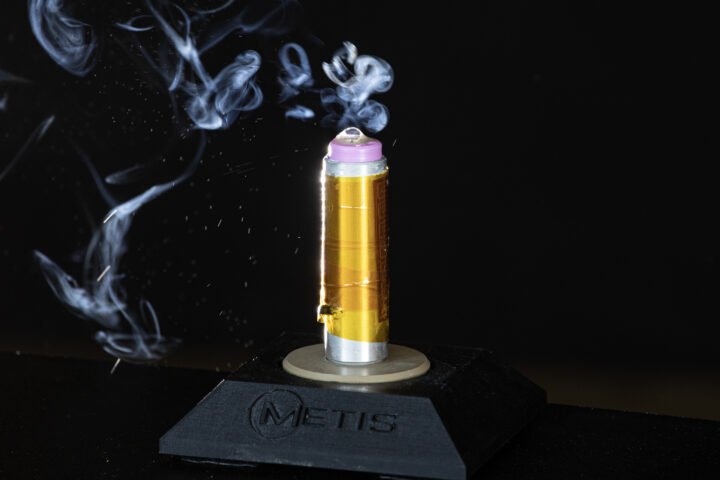
Metis Engineering has built its range around one principle: every sensor should arrive ready for the CAN network. Each unit has configurable bus speed and address and ships with a CAN database (DBC) file, so engineers can decode the data in the tools they already use. There is no proprietary software layer and no intermediate box to configure.
This removes most of the effort that normally sits between buying a sensor and getting trustworthy data from it. A sensor used on an early development rig can then follow the programme into prototype and production vehicles without the measurement chain being redesigned.
Bringing analogue and thermal data onto the bus
Many of the most important measurements on a vehicle still begin as analogue signals. Pressure transducers, position sensors, strain gauges and legacy instrumentation all produce voltages the network cannot read directly.
The Metis Analogue to Digital CAN Module converts eight 0 to 5 V inputs at 12-bit resolution, in steps of around 0.003 V, at sampling rates up to 333 Hz. It also measures PWM duty cycle and frequency, monitors digital inputs and includes a pulse counter for wheel speed, traction control and other motion-based measurements. Eight channels of mixed analogue and digital data reach the network through one compact module.
Temperature measurement in electrified systems is harder. Thermocouples placed on cells, busbars or power electronics sit in high-voltage environments, where ground loops and leakage currents corrupt readings and can create a safety hazard. The Metis 8-Channel Isolated Thermocouple module isolates each channel to more than 1,000 VDC, removing any current path through the thermocouple leads. It measures from -200°C to +1,800°C at up to 40 Hz per channel, with accuracy of ±0.5°C between 0 and 85°C, and supports K, J, T, N, S, E, B and R thermocouple types. Open-circuit and short-circuit detection flags broken or shorted wires before they produce misleading data.
Both modules are built for the environments they serve and accept 9 to 32 V supplies. The thermocouple module adds potted electronics, DIN rail mounting and IP67-rated connectors, so modules can be daisy-chained as channel counts grow.
Intelligence at the edge
As vehicle networks get busier, sensors that transmit constantly whether or not anything has changed become a liability. Bus load rises, power consumption increases and the data that matters gets harder to find.
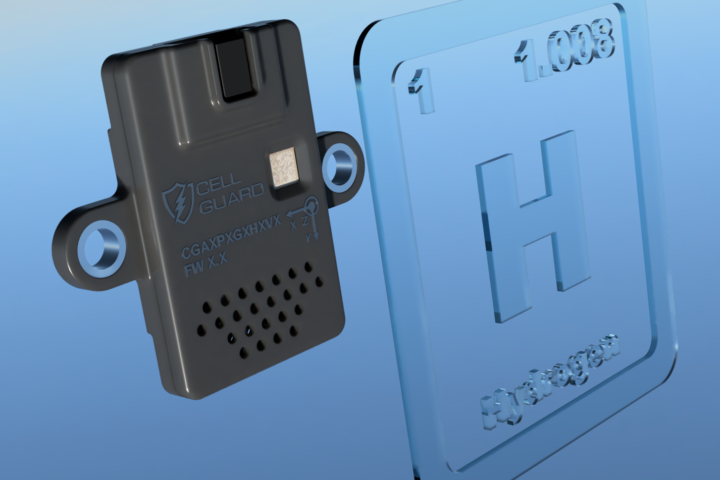
H Guard and Air Wise address this with a low power monitoring mode. The sensor watches its environment continuously but stays silent on the bus until a user-defined threshold is crossed, then switches to full operation and transmits. A 500 mA low-side drive output can trigger a hardware response directly, such as a fan, valve or contactor, without waiting for a central controller to process the message. Cell Guard offers a comparable wake-up function for battery packs.
This is how sensing should scale in electrified vehicles: local action where speed matters, network data where coordination matters.
From the desk to the vehicle
Integration risk is lowest when engineers can evaluate a sensor before it goes anywhere near a vehicle. The Metis Nano Development Kit and R&D Development Kit connect sensors to a PC for live analysis on the desk, so teams know how the hardware behaves before it moves to a rig or prototype.
The same products are now reaching a wider set of industries. Since Miken Electronics Worldwide was appointed global distribution partner in May 2026, the full Metis range has been available to defence, aerospace and industrial customers, alongside the automotive, motorsport, marine and energy storage engineers who already use it.
Where vehicle tech goes next
Software-defined vehicles, zonal architectures and over-the-air updates will change how automotive electronics are organised. They will not reduce the need for accurate physical measurement delivered reliably to the systems that act on it. They raise the bar, because a control strategy that can be updated in software is only as good as the data it receives.
The engineering teams that move fastest will stop treating sensor integration as a project in its own right. Specify sensors that arrive ready for the network, with configuration, documentation and diagnostics already in place, and engineering time goes back into the vehicle.