There is a moment in almost every test programme when the temperature channel count starts to climb. A prototype battery module needs twelve thermocouples. Then the full pack needs sixty. Then the thermal team wants coolant inlet and outlet temperatures on every plate, the powertrain team wants motor winding and inverter temperatures, and suddenly a rig that began with one small data logger is sprouting cables in every direction. This is where a distributed CAN thermocouple network earns its place.
The trouble with centralised acquisition
The traditional approach is to route every thermocouple back to a central data acquisition chassis. It works, but it scales badly. Thermocouple extension cable is relatively expensive, must be of the correct type all the way back to the cold junction, and is vulnerable to damage, noise pick-up and connector errors. Long runs across a vehicle or test cell take time to install and even more time to fault-find. Adding channels often means buying another expensive card or a whole new chassis.
A distributed approach flips this around. Instead of bringing every thermocouple to the logger, the measurement is made close to the sensor and the digital result is sent over a single network cable. Thermocouple leads stay short, and the only thing that runs the length of the rig is the CAN bus.
How a CAN thermocouple network is built
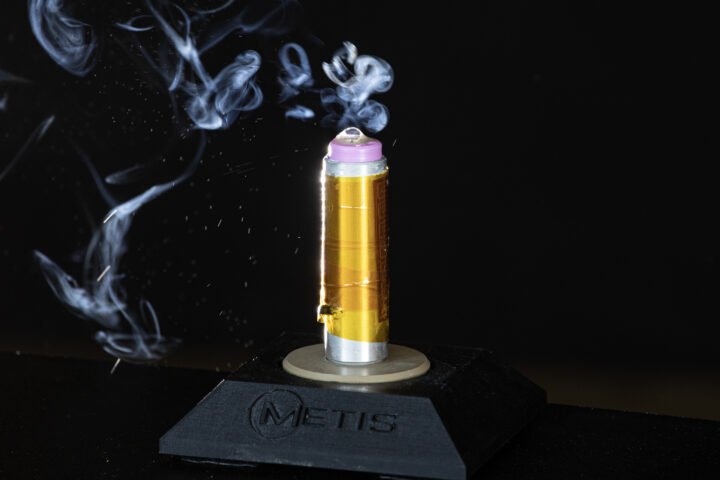
Metis Engineering’s 8 Channel Isolated Thermocouple to CAN module is designed as a building block for exactly this approach. Each module accepts eight thermocouples and converts them to calibrated temperature readings on the CAN bus at up to 40 Hz per channel. It has two IP67-rated JWPF connectors, one in and one out, so modules can be daisy chained. According to Metis, up to 128 additional modules can be connected in a single chain, enabling a very large number of measurement channels.
Because the CAN address and bus speed are configurable on each module, every unit on the chain has its own identity and messages do not collide. The supplied DBC file describes every signal, so a logger or analysis tool can decode all the channels on the network without any custom configuration.
Fewer cables, faster set-up
The practical benefits show up on day one. A module can be mounted right next to the battery module, motor or exhaust it is measuring, on a DIN rail or bracket, with thermocouple leads only as long as they need to be. A single CAN and power harness then links all the modules together and back to the logger or vehicle network.
When the test changes, as it always does, reconfiguring is straightforward. Moving a module to a different part of the rig means moving one unit and one harness connection rather than rerouting eight long extension cables. Adding channels means adding a module to the end of the chain.
Data that is already synchronised
One of the less obvious advantages of a CAN thermocouple network is that the temperature data arrives on the same bus as everything else. On a vehicle or battery rig, that bus already carries cell voltages, currents, pump speeds, fan commands and BMS status. Logging it all through one interface keeps the timestamps aligned, which makes it far easier to correlate a temperature excursion with the current step or coolant flow change that caused it.
Temperature data can also be used in real time as well as logged. A control system on the same network can read the thermocouple channels directly and use them in thermal management strategies, test sequencing or safety interlocks, for example stopping a charge cycle if a cell surface temperature exceeds a limit.
Isolation still matters at scale
As channel counts grow, so does the risk of electrical interference. Large rigs often mix high-voltage batteries, inverters, dynamometers and mains-powered test equipment, creating an environment full of common-mode voltages and switching noise. Each channel on the Metis module is galvanically isolated to 1,000 VDC, which prevents ground loops forming between thermocouples at different potentials and protects measurement integrity across the whole network.
Open-circuit and short-circuit detection on every channel adds another layer of protection. On a rig with hundreds of thermocouples, a single failed sensor is easy to miss. Built-in diagnostics flag the fault on the network so it can be fixed before it undermines a long test.
Accuracy that holds across the range
Scaling up should not mean compromising accuracy. The module delivers ±0.5°C from 0 to 85°C and ±1°C from minus 40 to 125°C, with 0.04°C resolution. Type K connectors are standard, with Types J, T, N, S, E, B and R available, covering temperatures from minus 200°C to plus 1,800°C depending on thermocouple type. A supply range of 9 to 32V suits both vehicle and laboratory power.
Mixing measurement types on one bus
Temperature is rarely the only measurement a rig needs. Pressure transducers, flow meters, potentiometers and other analogue sensors can join the same network via the Metis Analogue to Digital CAN Module, a 12-bit, eight-channel unit that reads 0 to 5V signals at up to 333 Hz. Navigation, inertial and environmental sensors from the Metis range also speak CAN natively. The result is a single, coherent data network rather than a patchwork of separate systems.
Build it once, grow it as needed
A distributed CAN thermocouple network handles today’s channel count and removes the need to redesign the acquisition system every time the test programme grows. For battery developers, powertrain teams, motorsport engineers and industrial test labs, that flexibility shortens set-up and protects test schedules.
To discuss scaling temperature measurement on your rig, contact the Metis Engineering team at info@metisengineering.com.