Volatile organic compounds reveal when a battery cell is venting, when a hydrogen system is compromised and when cabin air is degrading. Most vehicles measure none of them.
Engineers have long treated volatile organic compounds as an air quality issue, a matter for HVAC specialists and occupational health regulation. That view underestimates them. In electrified and hydrogen vehicles, VOCs are among the earliest and most dependable indicators that something is going wrong, and they matter in three places usually engineered in isolation: the battery pack, the hydrogen system and the cabin.
A vehicle architecture that recognises this can detect a wider range of failures with fewer, better specified sensors.
In the battery pack: the first sign of cell failure
When a lithium-ion cell is damaged or overheating internally, its electrolyte begins to decompose and the cell vents. The vapour released is rich in VOCs. Because a sealed cell should never vent, any rise in VOC concentration inside a pack means something.
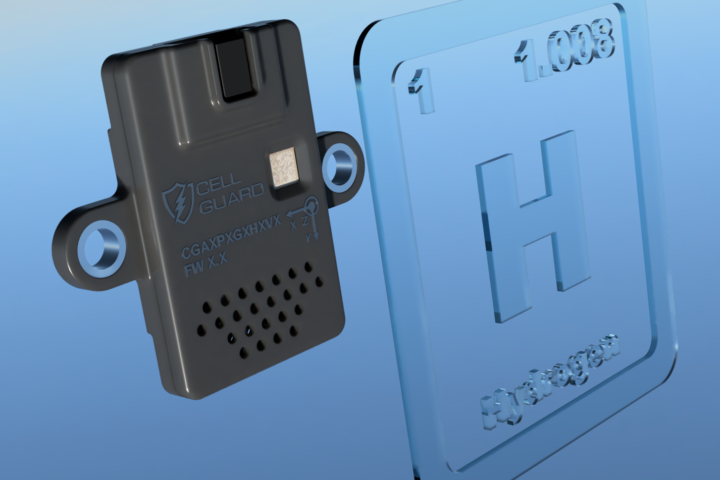
VOC detection responds far earlier than temperature or voltage. Independent testing by Sandia National Laboratories, published in the Journal of the Electrochemical Society, found that Metis Engineering’s Cell Guard detected thermal runaway signatures in under 60 seconds, with VOC and combined gas sensing giving around seven minutes of warning before runaway. Hydrogen, by comparison, was detected less than a minute before runaway.
For system designers, the choice of target gas matters as much as fitting a sensor at all. Hydrogen is a useful later stage indicator and a marker of moisture-driven electrolysis. VOCs are the early indicator. Cell Guard measures both, along with pressure, humidity and dew point, so the BMS receives a full picture of conditions inside the pack.
In hydrogen systems: context for every leak
Hydrogen vehicles and infrastructure carry a different primary risk. Hydrogen is flammable in air between 4% and 77%, ignites with very little energy and cannot be seen or smelt. Leak detection is mandatory in practice, whatever the regulation says.
Measuring hydrogen alone leaves engineers without context. Fuel cell stacks, compressors and hydrogen combustion engines operate alongside lubricants, seals and polymers that release VOCs as they age or overheat, and oil vapour can degrade some hydrogen sensing technologies.
H Guard, derived from the Cell Guard platform, measures hydrogen from 0 to 20% concentration, well beyond the 4% lower flammability limit, alongside VOCs, pressure, temperature, humidity and dew point. It is designed to resist oil poisoning, operates from -40°C to +85°C, gives readings immediately at start-up with no warm-up period and draws less than 1 mA in standby. Its 500 mA low-side drive output can switch ventilation or isolation hardware directly when a threshold is breached. H Guard can also be fitted in battery packs, where it identifies hydrogen produced by electrolysis after water ingress.
In the cabin: air quality as a safety and efficiency issue
Inside the vehicle, VOCs come from interior materials, exhaust from surrounding traffic, cleaning products and the occupants themselves. Combined with rising carbon dioxide in a closed cabin, they affect driver alertness and passenger comfort. In autonomous pods, shuttles and buses with no driver to open a window, cabin air management becomes the system’s responsibility.
It is also an energy question. HVAC is one of the largest auxiliary loads on an electric vehicle’s battery. Ventilation driven by measured air quality, rather than fixed schedules or maximum fresh air settings, protects range without compromising the people on board.
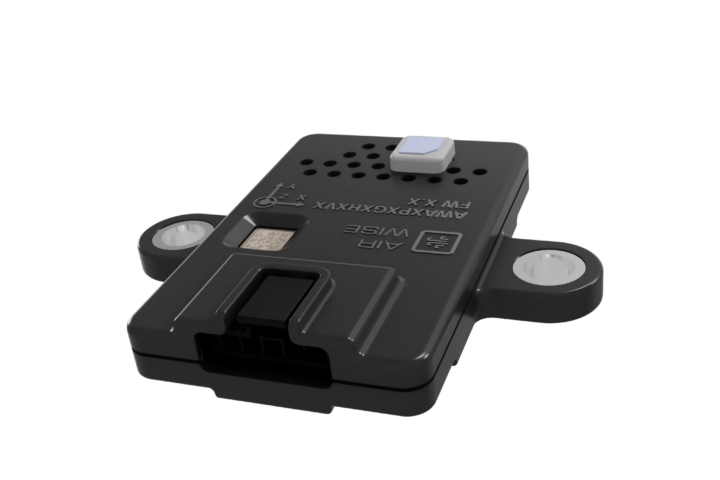
Air Wise brings this capability onto the CAN network. It measures VOCs, carbon dioxide, nitrogen oxides, absolute pressure, air temperature, relative humidity, dew point and impact shock in a unit measuring 14 x 35 x 120 mm. Like H Guard, it can monitor silently and transmit only when a threshold is crossed, triggering a 500 mA output to start a fan or switch to recirculation. It is designed for passenger and commercial vehicles, off-highway machinery, autonomous vehicles and pods, and compressed air systems.
One platform, three applications
Cell Guard, H Guard and Air Wise share a common platform. Each is CAN-based, has configurable bus speed and address, ships with a DBC file, connects through a 5-pin automotive-grade Molex Nano-Fit connector and has been tested to automotive standards including ISO 7637-2 and ISO 16750.
For a vehicle programme, that consistency pays off in practical ways. Software teams decode all three with the same tools. Electrical teams use the same harness approach. Validation data from one application informs the next. Rather than three supplier relationships for pack safety, hydrogen safety and cabin air quality, a single sensing architecture covers all three.
What engineering teams should ask
Specifying a VOC detector well comes down to a handful of practical questions. Where will vented gas or leaked hydrogen travel first, and is the sensor positioned there? Is it measuring the gas that appears earliest for this failure mode, or one that confirms failure after the fact? Can it run continuously on minimal power while the vehicle is parked? Does its output reach a controller, or a piece of hardware, that can act in the time available?
Programmes that settle these questions at concept stage end up with safety systems that buy time. Programmes that defer them tend to find the gap during validation, or in the field.
VOC detection was once a comfort feature. In electrified and hydrogen vehicles it is part of the safety case, and it deserves the same rigour in specification as the battery management system it protects.