For years, battery safety requirements for electric vehicles were built around a pragmatic compromise. If a cell entered thermal runaway, the aim was to give occupants enough warning to get out of the vehicle before fire or explosion. That compromise is now being replaced by far tougher expectations, and the data captured by a pressure sensor in the battery pack is moving from a useful extra to a central part of how manufacturers demonstrate safety, manage risk and extract value from batteries over their whole lives.
A step change in regulation
China’s previous traction battery standard, GB 38031-2020, required a warning at least five minutes before fire or explosion following thermal runaway in a cell. Its replacement, GB 38031-2025, applies to new type approvals from 1 July 2026 and goes much further. A battery system must produce no fire and no explosion for at least two hours after thermal runaway, an alarm must be raised within five minutes, and smoke must not endanger occupants. The new standard also introduces tests such as bottom impact and post-fast-charge safety.
China is the world’s largest EV market, and its rules shape global battery design. Other regions are also reviewing their requirements. For manufacturers, the direction is clear: early warning and effective mitigation are becoming non-negotiable.
Why detection matters even when containment improves
Much of the engineering response to tougher rules focuses on containment: better cell spacing, thermal barriers, venting channels and cooling. These are essential. But containment and detection work together. The earlier a failing cell is identified, the sooner the system can isolate the pack, adjust cooling, warn occupants and, in stationary systems, trigger suppression. Detection also generates the evidence that an alarm was raised within the required time.
Cell venting is one of the earliest reliable signs of a cell failure, and it produces a pressure change inside the enclosure. With pressure sensor battery pack monitoring, a sensor near the breather path sees that change regardless of where in the pack the failing cell is located.
Pressure and gas together
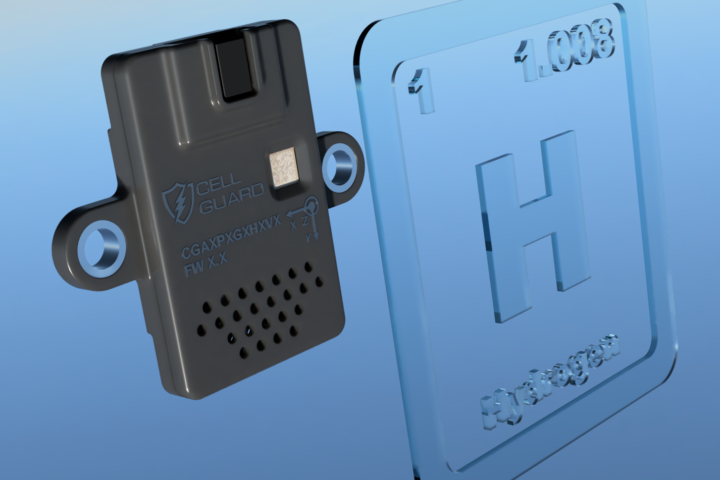
Metis Engineering’s Cell Guard combines absolute pressure measurement, with 0.0001 bar resolution and updates at up to 50 Hz, with volatile organic compound detection, air temperature, humidity, dew point and optional shock measurement. Pairing a pressure step with a VOC spike provides a robust signature of venting and helps avoid false alarms.
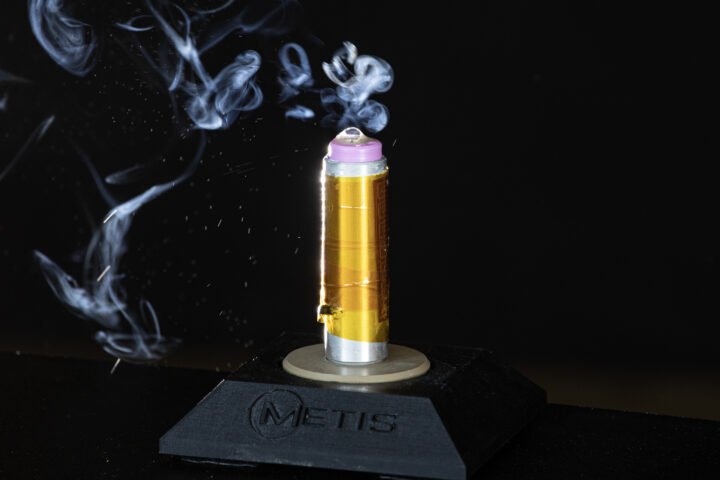
The approach has independent support. Sandia National Laboratories evaluated Cell Guard alongside two competing products and published the results in the Journal of the Electrochemical Society. Cell Guard detected the thermal event in under 60 seconds, while a hydrogen-only competitor took seven minutes longer.
Data for insurers and assessors
Regulation is only one pressure. Insurers are increasingly cautious about EV battery risk, and there are well-documented cases of vehicles being written off after minor impacts because the condition of the battery could not be verified. Without evidence, the cautious decision is often the expensive one.
A battery pack fitted with pressure, humidity and shock sensing builds a record that helps answer those questions. Did the pack suffer a significant impact? Has there been moisture ingress? Has any cell vented? Cell Guard’s optional accelerometer records shock load and duration up to ±24g, and its humidity and dew point measurements show whether the enclosure has remained sealed. That evidence can support decisions to repair rather than scrap a pack, and it can reassure insurers assessing risk.
Supporting battery passports and second life
Europe’s move towards digital battery passports reflects a wider desire for transparency about battery condition and history. Batteries that leave vehicles still have substantial capacity, and second-life applications in energy storage depend on buyers trusting their condition.
Continuous data from a pressure sensor battery pack monitoring system adds valuable context to that history. A pack with a clean record of pressure, humidity and shock data is easier to assess, value and redeploy than one with no environmental history at all. Cell Guard works across NMC, LFP and LMFP chemistries, making it relevant to the broad mix of batteries likely to enter second-life markets.
Designed to fit production programmes
For sensing to support compliance, it must meet production expectations. Cell Guard has been developed in line with ISO 26262 processes, tested to ISO 7637-2:2011, ISO 16750-2:2012 and ISO 16750-4:2010, and is used by OEMs and Tier 1 suppliers in ASIL B applications. It has been deployed in more than 500 systems across electric vehicles, energy storage and industrial applications, and Metis Engineering is certified to ISO 9001.
Integration is designed to be simple. Cell Guard communicates over CAN bus with configurable address and baud rate and ships with a DBC file. In low power mode it continues monitoring while the system is idle, waking the network and toggling a 500 mA low-side drive output when a threshold is crossed. For large energy storage installations, more than 100 units can be daisy chained.
What operators should do now
For OEMs and energy storage integrators, the practical step is to treat pressure sensor battery pack data as a design input from the first prototype, rather than an option added late. That means allocating CAN bandwidth and BMS logic to act on venting alerts, defining what is logged over the life of the pack, and deciding how that record will be shared with insurers, service networks and second-life buyers. Programmes that plan for this early avoid costly redesign when regulators, customers or insurers start asking for evidence.
Data as a strategic asset
As regulation tightens and the market for used batteries grows, battery data is becoming a strategic asset. Pressure sensing, combined with gas, humidity and shock measurement, turns the inside of the battery pack from a black box into a monitored environment, supporting safety compliance today and asset value tomorrow.
To discuss how Cell Guard can support your battery safety and data strategy, contact Metis Engineering at info@metisengineering.com.