The air inside a vehicle cabin is rarely as clean as its occupants assume. New interior materials release compounds for months after manufacture. Traffic fumes and diesel exhaust are drawn in through the ventilation system. Exhaled carbon dioxide accumulates quickly when several people share a small space with the windows closed. Increasingly, vehicle and machinery designers are responding by fitting a VOC detector, alongside other air quality sensors, directly into the HVAC system.
What VOCs are, and where they come from
Volatile organic compounds are carbon-based chemicals that evaporate readily at room temperature. In a vehicle, they come from two main sources. Inside the cabin, adhesives, plastics, foams, textiles and coatings off-gas VOCs, particularly when new or when the interior heats up in the sun. Outside, road traffic, fuel vapour and industrial activity add VOCs and nitrogen oxides to the air the HVAC system draws in.
Exposure to elevated VOC levels is associated with headaches, fatigue, eye and throat irritation and, over time, more serious health effects. For professional drivers, machine operators and passengers on long journeys, cabin air quality is not simply a matter of comfort.
Why CO2 matters just as much
A VOC detector is most effective when it works alongside carbon dioxide measurement. CO2 is the most widely used proxy for ventilation performance. As occupancy rises, so does CO2, and when levels climb above roughly 1,000 ppm, occupants begin to report reduced concentration, drowsiness and discomfort. In a vehicle, that has obvious safety implications for the driver.
Measuring both allows an HVAC controller to make smarter decisions. Rising CO2 with low outdoor pollution calls for more fresh air. Rising outdoor VOCs or NOx in heavy traffic suggests switching to recirculation, but not for so long that CO2 builds up inside. Without both measurements, the system has to guess.
Air Wise: a multi-parameter VOC detector for HVAC
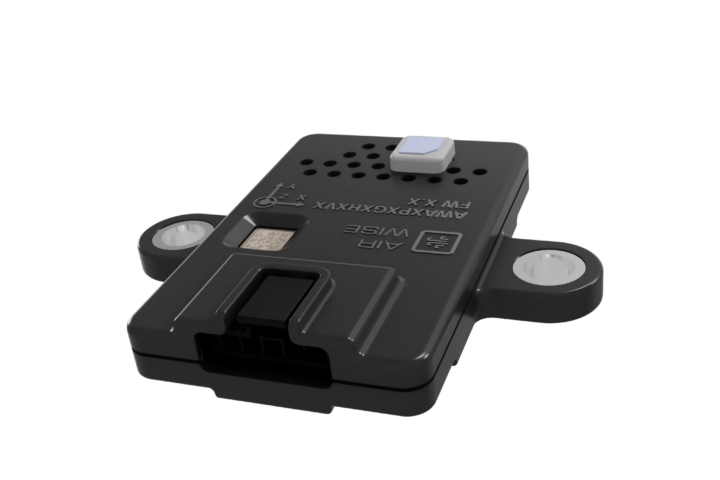
Metis Engineering developed Air Wise to give HVAC systems the data they need to make those decisions automatically. Air Wise is a CAN-based sensor that measures VOCs from 0 to 6,553.5 ppm, carbon dioxide up to 40% by volume, nitrogen oxides from 0 to 1 ppm, absolute pressure, air temperature, relative and absolute humidity, dew point temperature and impact shock up to ±24g.
Humidity and dew point data add a further dimension. They allow the climate system to anticipate window misting and manage condensation, improving visibility and reducing unnecessary energy use in defrost modes. Pressure data supports altitude compensation and can help identify blocked filters or ducting.
Smart monitoring without network clutter
In a vehicle, the HVAC controller is one of many devices sharing the CAN bus, and bandwidth is valuable. Air Wise includes an intelligent monitoring mode in which the sensor continuously observes the environment but does not transmit until a user-defined threshold is exceeded. When that happens, it switches to active mode, streams data and can activate a 500 mA low-side drive output to trigger a fan, damper or warning directly.
This keeps the network quiet during normal conditions while ensuring an immediate response when air quality deteriorates, whether that is a VOC spike from a nearby exhaust or a gradual CO2 build-up during a long shift.
Built for vehicles and machines
Air Wise integrates into HVAC CAN bus systems via an automotive-grade 5-pin Molex Nano-Fit power connector. It has been tested to automotive standards including ISO 7637-2:2011, ISO 16750-2:2012 and ISO 16750-4:2010, and has an operating temperature range of minus 20°C to plus 70°C. The CAN address and baud rate are configurable and a DBC file is supplied, so integration into an existing vehicle network is straightforward. For bench evaluation, Air Wise works with the Metis Nano Development Kit.
Typical applications include passenger cars, buses and coaches, commercial vehicles, off-highway machinery such as construction and agricultural equipment, autonomous vehicles and pods, and compressed air systems.
A growing regulatory and commercial driver
Regulatory pressure on air quality is tightening across transport, construction, agriculture and industrial sectors, and operators are paying closer attention to the working environment of drivers and machine operators. For autonomous pods and shared mobility services, where there may be no driver to open a window, automatic air quality management becomes part of the passenger experience itself. A VOC detector integrated into the HVAC system provides the evidence that the cabin environment is being actively managed.
Placing the VOC detector correctly
Where the sensor sits determines what it sees. A VOC detector mounted in the fresh air intake reports what the vehicle is drawing in from outside, which is the right input for recirculation decisions. One mounted in the cabin return air path reports what occupants are breathing, which is the right input for ventilation rate and comfort. Many HVAC strategies benefit from both. Because Air Wise units communicate over CAN with configurable addresses, two sensors can share the same network without conflict, giving the climate controller a direct comparison between outside and inside air and a firm basis for switching modes.
Energy efficiency as a bonus
Demand-controlled ventilation is also an energy saving measure. Heating or cooling large volumes of fresh air is one of the biggest auxiliary loads on an electric vehicle. By ventilating according to measured need rather than a fixed schedule, an HVAC system equipped with VOC and CO2 sensing can reduce energy consumption and help protect driving range.
From measurement to intelligence
As Joe Holdsworth, Founder and CEO of Metis Engineering, put it at the launch of Air Wise, the aim was to create a sensor that gives engineers the intelligence to act on air quality in real time. For vehicle and machinery designers, a CAN-connected VOC detector is a practical step towards healthier, safer and more efficient cabins.
To discuss Air Wise for your HVAC application, contact info@metisengineering.com.