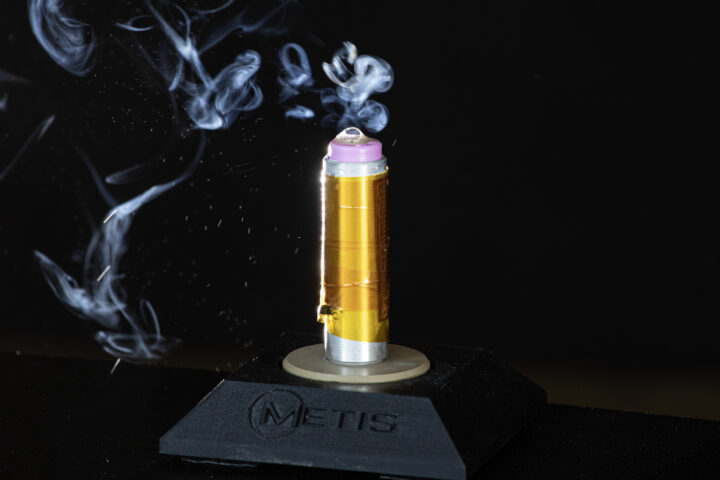
Battery development has driven much of the recent demand for isolated, multi-channel temperature measurement, but the CAN thermocouple is far from a single-industry tool. Wherever temperatures need to be measured at several points, in a harsh environment, and fed into a system that already uses CAN, the same technology applies. The applications below run from liquid nitrogen to exhaust manifolds.
Why thermocouples remain the workhorse
Thermocouples work on a simple principle. Two dissimilar metals joined at one end generate a small voltage that varies with temperature. They need no excitation, can be made very small, respond quickly and tolerate vibration and shock far better than most alternatives. Different metal combinations cover different temperature ranges, which is why there are several standard types.
The trade-off is that the signal is tiny, just tens of microvolts per degree, and highly susceptible to noise and ground loops. It also needs cold-junction compensation and linearisation to turn it into an accurate temperature. A dedicated CAN thermocouple module handles all of this, converting each channel to a calibrated digital value close to the sensor and sending it over a robust network.
Choosing the right thermocouple type
Metis Engineering’s 8 Channel Isolated Thermocouple to CAN module ships with Type K miniature connectors as standard, and Types J, T, N, S, E, B and R are also supported. Across those types the module covers a range from minus 200°C to plus 1,800°C.
Type K is the general-purpose choice, spanning from minus 200°C to plus 1,372°C, which suits everything from ambient monitoring to exhaust gas temperatures. Type T is favoured for low-temperature and cryogenic work. Type N offers improved stability at high temperatures. Types S, R and B, based on platinum and rhodium, extend measurement into the range of furnaces, kilns and high-temperature processes, with Type B reaching 1,800°C. Being able to use the same acquisition hardware across all of these simplifies spares, training and software.
Cryogenics and low-temperature research
At the cold end of the scale, hydrogen and cryogenic research demand reliable measurement well below zero. Liquid hydrogen storage, superconducting systems and low-temperature materials testing all need thermocouples that can reach minus 200°C and below, together with electronics that stay accurate and stable. A CAN thermocouple module mounted close to the test article keeps lead lengths short and reduces the chance of noise pick-up in large, electrically busy facilities.
Engines, exhausts and aftertreatment
Internal combustion engines, whether running on diesel, gasoline or hydrogen, still need extensive thermal characterisation. Exhaust gas temperatures, turbocharger inlet and outlet temperatures, catalyst bed temperatures and aftertreatment system temperatures all feed calibration and durability work. Here, a high sample rate matters. At up to 40 Hz per channel, the Metis module captures transient events during load steps and regeneration cycles rather than averaging them out.
Because engine test cells and vehicles already run CAN, the thermocouple data can be logged alongside ECU signals with aligned timestamps, which is essential when correlating a temperature spike with an injection or boost event.
Motorsport and high-performance vehicles
Metis Engineering’s customer base includes Formula E, the World Rally Championship and the Bloodhound Land Speed Record project, and motorsport shares many of the same demands. Brake discs, tyre surfaces, gearbox oil, hybrid systems and battery packs all need monitoring, often in cramped spaces with severe vibration and limited power. A compact, potted module with IP67 JWPF connectors and a 9 to 32V supply range suits the environment, while a single CAN connection keeps wiring weight and complexity down.
Power electronics and electrical machines
Inverters, DC-DC converters and electric motors present a particular challenge. Temperature sensors bonded to power semiconductors, busbars or motor windings sit in intense electric and magnetic fields, and sometimes at high voltage. Each channel of the Metis module is galvanically isolated to 1,000 VDC, preventing ground loops and interference that could compromise readings and protecting the acquisition system from the voltages present in the device under test.
Industrial processes and energy systems
In manufacturing, heat treatment, plastics processing and food production all rely on accurate multi-point temperature measurement. In energy systems, from battery storage containers to hydrogen electrolysers and fuel cells, thermal monitoring is part of both performance optimisation and safety. The ability to DIN rail mount the module, daisy chain many modules over one CAN network and integrate them into existing control systems makes it a natural fit for industrial automation where CAN or CANopen-style networks are already in use.
Diagnostics for unattended systems
In long-running or unattended installations, a failed thermocouple can go unnoticed for a long time. The Metis module’s open-circuit and short-circuit detection flags broken, disconnected or shorted sensors on the network, reducing maintenance overhead and preventing decisions being made on bad data.
Accuracy you can rely on
Across applications, the module offers accuracy of ±0.5°C from 0 to 85°C and ±1°C from minus 40 to 125°C, with 0.04°C resolution. Configurable CAN address and bus speed, plus a supplied DBC file, mean the data can be decoded in standard tools immediately.
One platform, many applications
A single CAN thermocouple module covers a wide spread of work. The same device that maps cell temperatures in a battery pack can monitor exhaust temperatures on an engine dyno, track brake temperatures on a rally car or watch a cryogenic storage vessel, all with the same software, connectors and integration approach.
To discuss how the 8 Channel Isolated Thermocouple to CAN module could support your application, contact Metis Engineering at info@metisengineering.com.