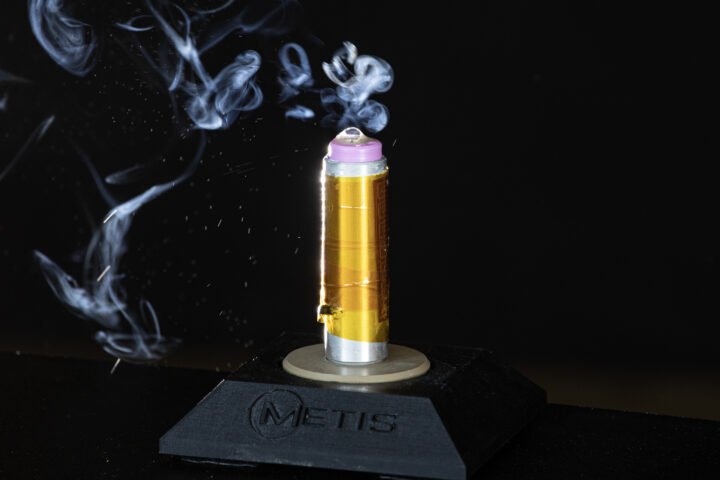
Specifying gas measurement instruments for a laboratory is a well-trodden path. Specifying them for a hydrogen-powered truck, an autonomous pod, an agricultural machine or a battery energy storage container is a very different exercise. Mobile and harsh environments place demands on a sensor that a benchtop analyser never has to face, and the wrong choice can mean false alarms, missed events or a sensor that simply stops working after a season in the field.
Drawing on Metis Engineering’s experience supplying CAN-based environmental sensors to more than 200 automotive, motorsport and energy storage customers, the six questions below decide whether a gas sensing solution protects the system or simply generates nuisance alarms.
Which gases actually matter?
The first step is to match the measurement to the hazard or the control objective. In hydrogen systems, from electrolysers and storage tanks to fuel cell electric vehicles and hydrogen internal combustion engines, the primary concern is leaks. Hydrogen is colourless and odourless, with a flammability range in air from around 4% to 77% by volume, so detection has to begin well below that lower limit.
In battery packs, the priority shifts to volatile organic compounds released when the electrolyte decomposes during cell venting, supported by pressure and humidity data. In vehicle cabins and HVAC systems, carbon dioxide is the key indicator of ventilation performance and occupant comfort, while VOCs and nitrogen oxides indicate pollutants drawn in from outside or released from interior materials.
Many applications involve more than one of these. That is why multi-parameter gas measurement instruments, which combine several gas channels with pressure, temperature and humidity in one housing, are increasingly the default choice for embedded systems.
Will it survive the environment?
Temperature range is the most obvious hurdle. A sensor mounted in a vehicle or an outdoor enclosure may see anything from a cold start in a northern European winter to high summer heat soak. H Guard, Metis Engineering’s hydrogen and environmental sensor, operates from minus 40°C to plus 85°C, making it suitable for installations where many commercial gas sensors would underperform.
Vibration, shock and electrical noise are just as important. Automotive electrical systems generate transients that can damage or confuse poorly protected electronics. Metis sensors are tested to automotive standards including ISO 7637-2 for electrical transients and ISO 16750-2 and ISO 16750-4 for electrical and climatic loads. They also use automotive-rated connectors, such as the Molex Nano-Fit power connector on Air Wise and H Guard.
Moisture is often overlooked. Condensation inside an enclosure can compromise both the sensor and the equipment it protects, which is why measuring relative humidity, absolute humidity and dew point alongside gas concentration adds real value.
Does it need to warm up?
Some gas sensing technologies require a warm-up period before readings stabilise. In a stationary plant that runs continuously, this may not matter. In a vehicle that is switched on and off many times a day, or a system that must be protected from the moment of power-up, it can leave a dangerous gap. H Guard delivers hydrogen readings immediately on start-up, with no warm-up needed.
How much power can you spare?
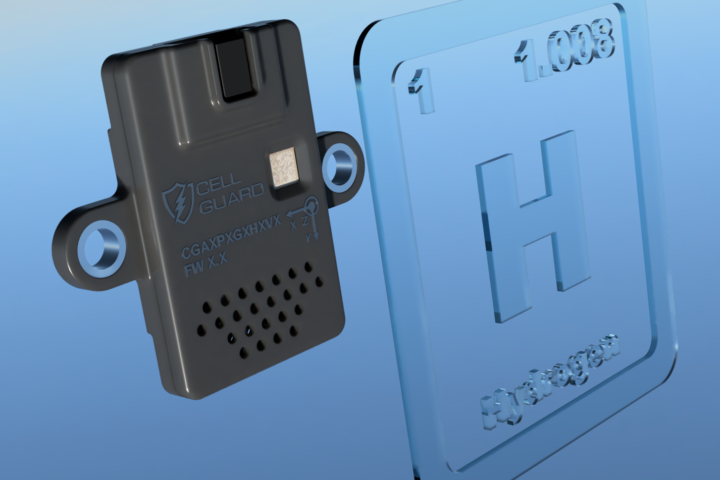
Mobile and off-grid systems are power constrained. A gas measurement instrument that must be monitored around the clock, including when a vehicle is parked, needs to draw very little current. H Guard, Cell Guard and Air Wise all feature a low power monitoring mode. In this mode the sensor continues to watch the environment but does not transmit on the CAN bus until a user-defined threshold is crossed. H Guard and Cell Guard with Hydrogen consume less than 1 mA in this state.
When a threshold is breached, the sensor wakes the CAN interface and toggles a low-side drive output capable of 500 mA, which can directly switch a fan, a relay, a warning lamp or a shutdown circuit. The sensor becomes part of the safety response itself.
Can it cope with interference?
Cross-sensitivity is one of the most common causes of false alarms. Energy storage systems, for example, often contain large quantities of adhesive, which can leave high background VOC levels for months after assembly. A sensor that relies on VOCs alone may struggle in that environment. Hydrogen-capable variants from Metis are designed to perform well in high-VOC surroundings, so thermal events and leaks can still be distinguished from the background.
How easily will it integrate?
Finally, consider integration effort. Analogue sensors need signal conditioning, calibration tables and careful wiring. Proprietary serial protocols need custom drivers. Metis Engineering’s gas measurement instruments communicate natively over CAN bus, with configurable address and baud rate, and each is supplied with a DBC file and quick start guide. Engineers can connect a sensor to an existing network, load the DBC and see decoded data in standard tools. For desktop evaluation, the Nano Development Kit provides a fast route to bench testing.
Matching the instrument to the job
For hydrogen leak detection across production, storage and mobility, H Guard measures hydrogen from 0 to 20% alongside VOCs, pressure, temperature, humidity and dew point, with an optional ±24g accelerometer. For battery packs, Cell Guard focuses on the early signatures of cell venting. For HVAC and cabin air quality in vehicles, off-highway machinery, autonomous pods and compressed air systems, Air Wise measures CO2 up to 40% by volume, VOCs, NOx, pressure, temperature, humidity, dew point and impact shock.
Choosing gas measurement instruments for harsh environments comes down to three risks: missed detection, nuisance alarms and costly integration. To discuss which Metis sensor best fits your system, contact info@metisengineering.com.