Hydrogen systems and battery energy storage systems are central to the energy transition, and both share a common safety challenge. Each houses large quantities of stored energy in an enclosure, and each can release gas when something goes wrong. In a hydrogen system, that gas is the fuel itself. In a battery system, it is the product of a failing cell. In both cases, a well-chosen pressure detection sensor, working alongside gas measurement, provides one of the earliest and most reliable warnings.
Two hazards, one principle
A hydrogen leak inside a fuel cell enclosure, a storage cabinet or a vehicle compartment raises the concentration of a highly flammable gas. Hydrogen is colourless and odourless, with a flammability range in air of around 4% to 77% by volume, so detection needs to start well below the lower limit.
In a battery enclosure, cell venting releases a mixture of volatile organic compounds, carbon dioxide, carbon monoxide and hydrogen. The released gas also produces a measurable change in enclosure pressure, often before temperature sensors elsewhere in the system register a problem.
In both cases, the enclosure volume behaves as a single measurement space. A pressure detection sensor placed in the air path will see a change regardless of exactly where the leak or vent originates.
Selection criterion one: absolute reference
Enclosures in hydrogen and storage applications may be installed outdoors, on vehicles or at altitude. An absolute sensor, referenced to vacuum rather than atmosphere, gives a stable baseline that does not drift with weather or elevation. That makes genuine events easier to separate from environmental change. Metis Engineering’s H Guard and Cell Guard both use absolute pressure sensing across 0.3 to 1.2 bar.
Selection criterion two: sensitivity and speed
Energy storage containers and large hydrogen installations can have significant internal air volumes, which dilutes the pressure effect of a small leak or single-cell vent. Fine resolution is therefore essential. Cell Guard resolves pressure to 0.0001 bar, with accuracy of 0.0005 bar from 0.3 to 1.1 bar, and updates at up to 50 Hz, so fast, subtle changes are captured.
Selection criterion three: gas measurement in the same device
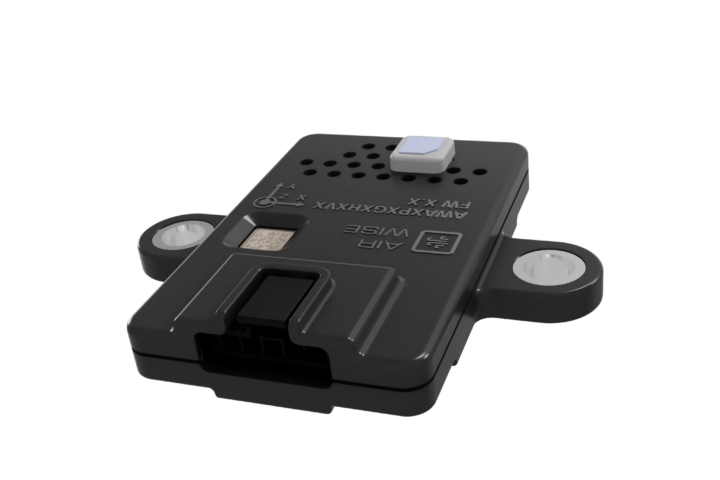
Pressure is most powerful when combined with direct gas measurement. H Guard pairs its pressure detection with hydrogen measurement from 0 to 20% by volume, alongside VOCs, air temperature, relative and absolute humidity, dew point and an optional triple-axis accelerometer up to ±24g. That means a single compact device can detect a hydrogen leak, a battery venting event or moisture formation, and cross-reference them to reduce false alarms.
H Guard supports hydrogen storage tanks and distribution networks, hydrogen combustion engines and fuel cell electric vehicles, electrolysers and other production units, and hydrogen-powered aviation, marine and industrial installations.
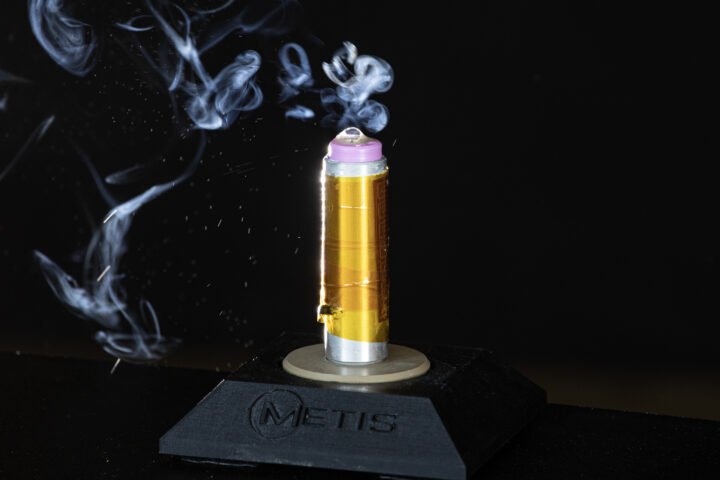
For battery-focused enclosures, Cell Guard combines absolute pressure with VOC detection optimised for electrolyte decomposition products. Independent testing by Sandia National Laboratories found that it detected a thermal event in under 60 seconds, while a hydrogen-only sensor took seven minutes longer.
Selection criterion four: performance in high-VOC environments
Energy storage systems often use large quantities of adhesives and sealants that leave high background VOC levels. That can make VOC-only detection difficult. Hydrogen-capable variants from Metis, including H Guard and Cell Guard with Hydrogen, are designed to continue detecting thermal events reliably even where ambient VOCs remain elevated.
Selection criterion five: temperature and power
Outdoor and mobile enclosures see wide temperature swings. H Guard operates from minus 40°C to plus 85°C. It also provides immediate hydrogen readings on start-up with no warm-up period, so protection begins the moment the system is powered.
Many hydrogen and storage assets spend long periods idle, and monitoring must continue throughout. In low power mode, H Guard draws less than 1 mA while continuing to watch the enclosure. It stays silent on the CAN bus until a configured threshold is crossed, then wakes the network and toggles a 500 mA low-side drive output that can switch ventilation fans, relays or alarms directly.
Selection criterion six: integration and scalability
Large installations may need many sensors. Every Metis sensor communicates over CAN bus with configurable address and baud rate and ships with a DBC file, so readings integrate directly with control systems and loggers. More than 100 Cell Guard units can be daisy chained for large energy storage installations, and automotive-grade Molex Nano-Fit connectors simplify wiring.
Selection criterion seven: proven robustness
Safety sensors must be qualified to recognised standards. H Guard has been tested to stringent ISO automotive compliance standards. Cell Guard has been developed in line with ISO 26262 processes, tested to ISO 7637-2:2011, ISO 16750-2:2012 and ISO 16750-4:2010, used in ASIL B applications and deployed in more than 500 systems.
Commissioning and baselining
A pressure detection sensor also needs a sound baseline. At commissioning, operators should log normal pressure behaviour across daily temperature cycles, ventilation operation and charge and discharge events. That record sets realistic alarm thresholds, so genuine leak or venting signatures stand out while routine fluctuations are ignored. Because Metis sensors stream data over CAN with a supplied DBC file, this baselining can be done with standard logging tools and repeated whenever the installation changes.
Protecting the energy transition
As hydrogen and battery storage scale up, the consequences of an undetected leak or venting event grow too. A pressure detection sensor that combines absolute sensing, high resolution, integrated gas measurement and low power operation gives operators the earliest possible warning and the data to act on it.
To discuss H Guard or Cell Guard for your hydrogen or energy storage project, contact Metis Engineering at info@metisengineering.com.