Adding a pressure sensor to a battery pack is one of the most effective ways to detect cell venting early. But the benefit depends heavily on choosing the right sensor. A device specified for tyre pressure, hydraulic systems or HVAC ducting may look similar on paper yet be poorly suited to the specific job of detecting a small, fast gas release inside a battery enclosure. Eight decisions determine whether pressure sensor battery pack monitoring will catch a venting cell.
Absolute or gauge?
The first decision is the pressure reference. A gauge sensor measures pressure relative to the surrounding atmosphere. An absolute sensor measures relative to a sealed vacuum reference.
For battery packs, absolute measurement has clear advantages. Atmospheric pressure changes with weather and, more significantly, with altitude. A vehicle driving from sea level to a mountain pass, or an energy storage system installed at altitude, will see its ambient reference shift considerably. With a gauge sensor, that shift can be difficult to separate from pack-internal events. An absolute sensor provides a stable, consistent baseline, so that a sudden step caused by a venting cell stands out clearly against slow environmental change.
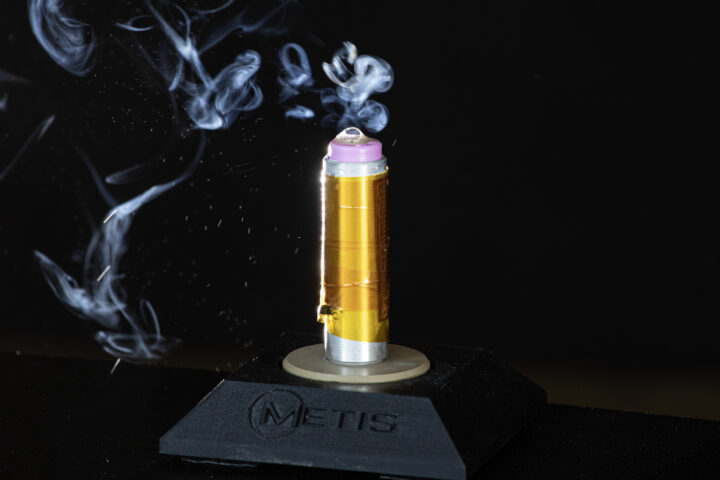
Metis Engineering’s Cell Guard uses absolute pressure sensing for exactly this reason.
What range do you need?
Battery enclosures typically operate close to atmospheric pressure, with breathers or pressure equalisation valves limiting how far internal pressure can deviate. The sensor range therefore needs to cover normal atmospheric variation, allow for altitude and leave headroom for venting events, without being so wide that resolution suffers.
Cell Guard covers 0.3 to 1.2 bar absolute. That spans the atmospheric conditions a vehicle or storage system will realistically encounter, from high altitude to high-pressure weather systems, while keeping the measurement range focused on the region where venting signatures appear.
How fine is the resolution?
Resolution determines the smallest change the sensor can detect. In a small module, a venting cell produces an obvious pressure spike. In a large pack with a big internal air volume, the same event produces a much smaller change, and the sensor must be able to see it.
Cell Guard resolves pressure to 0.0001 bar, with accuracy of 0.0005 bar across 0.3 to 1.1 bar. That sensitivity is sufficient to detect the subtle gas generation from a single cell venting even in large pack assemblies.
How fast does it update?
Venting is a rapid event. A slow sensor, or one that averages heavily, can blur the characteristic step into background noise. Cell Guard’s pressure channel updates at up to 50 Hz, capturing the dynamics of a venting event and allowing the control system to react quickly.
What else should it measure?
Pressure is powerful, but on its own it can be triggered by other causes: thermal expansion of the enclosure air during rapid heating or cooling, a breather valve operating, or mechanical disturbance. The most robust approach combines pressure with other indicators that change during a genuine venting event.
Cell Guard pairs its pressure channel with volatile organic compound measurement from 0 to 6,553.5 ppm, air temperature from minus 40 to 125°C, relative humidity, absolute humidity from 0 to 35,000 mg/m3, dew point, and an optional ±24g accelerometer. A simultaneous pressure step and VOC rise is a much stronger indicator than either alone. Humidity and dew point data also help protect liquid-cooled packs from condensation and identify seal failures before water ingress causes a fault.
How will it survive the environment?
A battery pack is a demanding place for electronics. The sensor will see vibration, thermal cycling, electrical transients from the vehicle supply and potentially moisture. Look for testing to recognised automotive standards. Cell Guard has been developed in line with ISO 26262 processes and tested to ISO 7637-2:2011, ISO 16750-2:2012 and ISO 16750-4:2010, and is used by OEMs and Tier 1 suppliers in ASIL B applications.
How will it integrate?
Integration effort is often the deciding factor. An analogue pressure transducer needs an input channel, scaling and calibration on the BMS. A CAN-native sensor can simply join the existing network. Cell Guard communicates over CAN with configurable address and baud rate, and a DBC file is supplied so readings appear as engineering values immediately. At 11.5 by 50 by 54.5 mm it fits most enclosures. Metis recommends mounting one unit per pack near the breather, and more than 100 units can be daisy chained for large energy storage systems.
Does it work when the system is off?
Battery incidents can occur when a vehicle is parked or a storage system is idle. A sensor that only reports while the main system is awake leaves a gap. Cell Guard includes a low power monitoring mode in which it watches the enclosure without transmitting until a threshold is breached. It then wakes the CAN interface and toggles a 500 mA low-side drive output, which can wake the BMS or trigger an alarm directly.
A specification checklist in prose
Pulling these points together, a pressure sensor battery pack specification for EV or ESS use should call for absolute sensing, a range that covers realistic altitude and weather with headroom for venting, resolution in the order of 0.0001 bar, an update rate of tens of hertz, and complementary VOC, humidity and temperature channels in the same device. It should require evidence of automotive testing, a CAN interface with a supplied DBC file and a low power monitoring mode with a direct output. A sensor that meets all of these can be integrated once and trusted across the life of the pack.
Specify for the event you want to catch
Pressure sensor battery pack monitoring should be designed around the event it needs to detect. Absolute sensing, a focused range, fine resolution, fast updates, complementary gas measurement and simple CAN integration together make the difference between a sensor that merely reports pressure and one that reliably flags a failing cell.
To discuss pressure monitoring for your battery pack, contact Metis Engineering at info@metisengineering.com.