


Enhancing Energy Storage System Safety and Lifecycle Decisions with Cell Guard Technologies
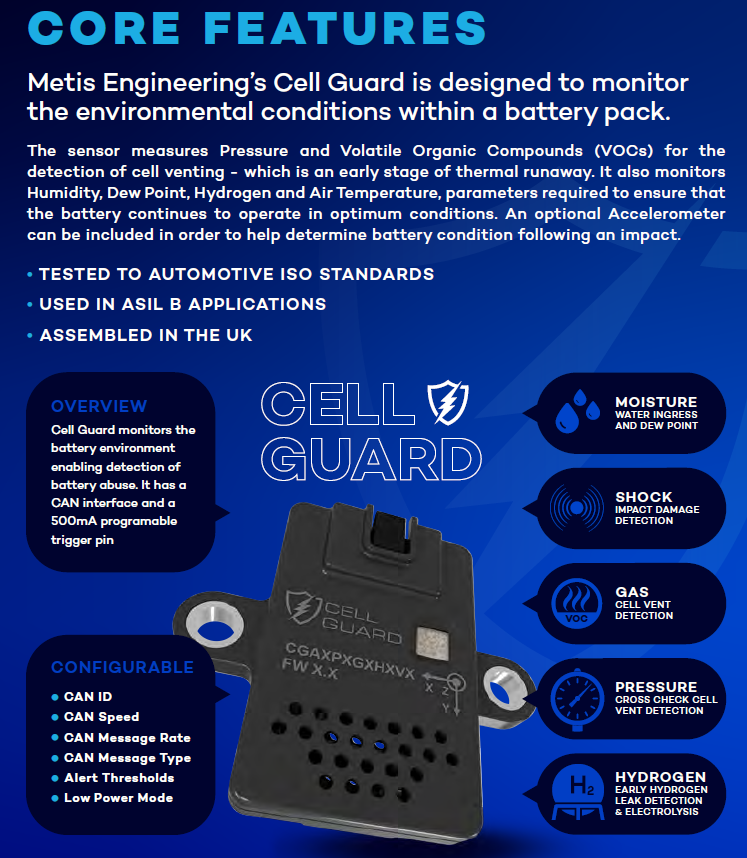
As the global transition to electrification accelerates, battery safety, longevity, and data-driven decision-making have never been more critical. Our Cell Guard sensor is at the forefront of this evolution, offering a compact, intelligent solution for real-time monitoring across a range of battery-powered applications. Designed to work consistently with NMC, LFP, and LMFP chemistries, the ISO Automotive Standard certified Cell Guard sensor is helping engineers unlock a new level of control in Electric Vehicle (EV) platforms and stationary Energy Storage Systems (ESS) alike.
Cell Guard is engineered for seamless integration within a battery pack or energy storage container, specifically designed to be installed near the breather port, an area critical for monitoring internal atmosphere changes. It’s compact, robust form factor allows it to fit snugly inside the enclosure without disrupting existing pack architecture or airflow.
At the core of Cell Guard’s capabilities is its high-sensitivity to cell venting (also known as off-gassing). During thermal runaway events, battery cells release gases – mostly Volatile Organic Compounds (VOCs), before more severe outcomes like fire or explosion occur. Cell Guard detects these early warning signs in real time, offering a critical window for system shutdown or containment. This functionality is essential across all EV types, from eVTOL and electric boats to passenger cars, racing cars and commercial trucks and buses to micromobility platforms like e-bikes and e-scooters, where early intervention can prevent costly damage, reputational risk, or injury.
Key Features
However, what truly sets the Cell Guard sensor apart is it’s always-on battery health monitoring. Beyond venting, the Cell Guard unit continuously tracks key environmental and physical parameters including:
- Moisture ingress, which can compromise insulation and lead to short circuits,
- Dew point and air temperature, particularly relevant in liquid-cooled packs, where condensation could occur inside the housing,
- Hydrogen presence, a byproduct in certain failure scenarios that signals dangerous conditions,
- Shock loads, offering detailed insight into the mechanical stresses a battery pack has experienced.
This last feature is especially valuable in post-incident assessment. If an electric vehicle is involved in a collision, Cell Guard can provide a precise record of the G-forces and shock duration the battery pack endured. This information enables engineers to make informed decisions: whether the pack can remain in service, be repurposed for second-life applications, or should be safely decommissioned and sent for recycling.
Stationary Energy Storage
For the growing market in stationary battery systems, whether grid-scale, commercial, or residential Cell Guard’s comprehensive sensor suite provides continuous oversight without adding significant complexity or cost. Operators gain peace of mind knowing they can detect environmental risks early and monitor battery performance over time, especially in outdoor or variable-temperature installations.
The Cell Guard sensor is a compact unit, lightweight, and easy to integrate into both new and existing battery architectures thanks to its fully programable CAN speed and address. For OEMs and system designers, it offers a practical, data-rich approach to meeting stringent safety regulations, enhancing battery traceability, and maximising return on investment through smarter lifecycle management.
In an era where battery packs represent a substantial share of system cost and safety considerations, Our Cell Guard sensor provides a powerful, proactive tool ensuring batteries remain healthy, safe, and intelligently managed from cradle to grave.
Case study
Allye, a pioneering energy storage company, is enhancing the safety and efficiency of its second-life static Energy Storage System (ESS) by integrating Metis Engineering’s Cell Guard with Accelerometer. These systems repurpose EV batteries into a 320kWh Battery Energy Storage System (BESS), offering significant cost reductions and a 60% decrease in embedded CO₂ emissions. To address the inherent uncertainties of second-life batteries, Allye conducts extensive testing to assess pack health and performance.

The Cell Guard sensor provides early detection of potential pack issues by monitoring environmental parameters such as VOCs, absolute pressure, relative humidity, and impacts. This integration allows Allye to proactively manage safety risks, ensuring reliable and sustainable energy storage solutions for various applications, including EV charging and grid support. Read the full case study.
Related products
-

H Guard
Easy integration into hydrogen systems to detect hydrogen leaks or early battery pack failure due to cell venting or formation of moisture.Price range: £105.60 through £132.00 exc VATCode: HGAXPXGXHXVX -

Air Wise
Next generation CAN based air quality HVAC sensorPrice range: £88.00 through £180.40 exc VATCode: AWAXPXGXHXVX -

R&D Battery Safety CAN Sensor
Price range: £164.00 through £204.00 exc VATCode: CANBSSGEN1 -

R&D Air Quality CAN Sensor
Price range: £164.00 through £204.00 exc VATCode: CANAIRQGEN1

SENSORS
Our line of CAN based Research and Development sensors allow easy integration into a CAN network.

SERVICES
Metis can also offer bespoke electronics and sensor packaging. For more information please get in touch.