Everything you need to know about Metis Engineering’s CAN-based sensor range, from battery safety to hydrogen leak detection.
Metis Engineering has built a reputation as one of the UK’s leading suppliers of CAN-based sensors for battery safety, hydrogen detection, and vehicle monitoring. This article answers ten of the questions most commonly asked about the company, its products, and how to work with it.
- What does Metis Engineering do?
Metis Engineering Ltd is a Bristol-based sensor specialist, founded in 2016, that designs and manufactures advanced CAN-based sensors for the automotive and energy storage industries. Its products monitor critical parameters such as battery health, hydrogen leaks, air quality, position, and motion. Customers span automotive, motorsport, aerospace, marine, and industrial energy sectors, with sensors used to improve safety, performance, and lifecycle decision-making across electric and hydrogen-powered systems. Alongside hardware, Metis offers consultancy services including training, installation support, data analysis, and bespoke sensor suite design.
- What is Cell Guard and how does it help prevent thermal runaway?
Cell Guard is Metis Engineering’s flagship CAN-based battery health sensor, designed to detect the early warning signs of thermal runaway in battery packs and energy storage systems. It measures volatile organic compounds (VOCs), absolute pressure, air temperature, humidity, dew point, and, as optional extras, hydrogen and shock load. Because cells release VOCs during off-gassing before more severe failure occurs, Cell Guard can give engineers a critical window to shut down or contain a system. Independent testing by Sandia National Laboratories confirmed its ability to detect thermal runaway faster than other methods.
- What is H Guard and how does it detect hydrogen leaks?
H Guard is a CAN-based hydrogen sensor built on the same platform as Cell Guard, designed for use across the hydrogen lifecycle, from production and storage to fuel cells and combustion engines. It detects hydrogen concentrations from 0 to 20 percent, well below hydrogen’s 4 percent lower flammability limit, alongside VOCs, pressure, temperature, and humidity. It also identifies hydrogen produced through electrolysis, which can indicate water ingress into a battery pack. H Guard operates from minus 40°C to plus 85°C, draws under 1mA in standby, and requires no warm-up before delivering readings.
- What is Air Wise, and what does it measure?
Air Wise is Metis Engineering’s CAN-based air quality sensor, aimed primarily at HVAC applications. Like the rest of the environmental sensor range, it uses a compact form factor and a Molex Nano-Fit connector for straightforward integration, monitoring cabin or ambient air quality parameters relevant to occupant comfort and system performance. It shares core design principles with Cell Guard and H Guard, including configurable CAN bus speed and address, making it easy to add to existing vehicle or building CAN networks alongside Metis’s other environmental sensors.
- What other sensors does Metis Engineering offer beyond the environmental range?
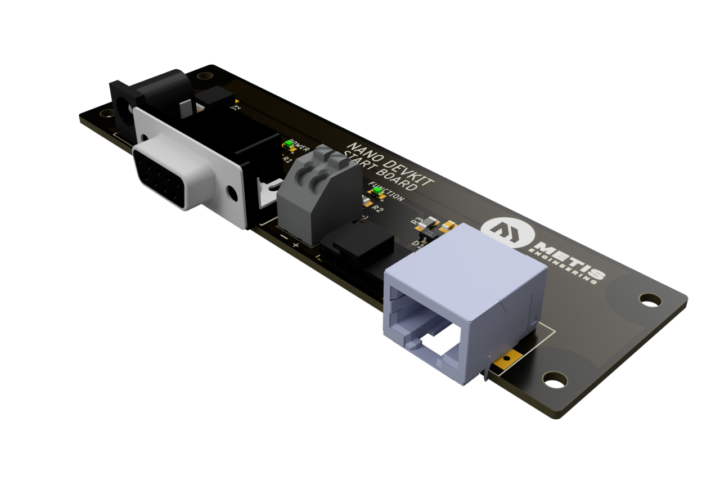
Beyond Cell Guard, H Guard, and Air Wise, Metis Engineering produces navigational sensors delivering GNSS/GPS, compass, and dead reckoning data for robotics, drones, and autonomous vehicles, and inertial sensors combining accelerometers, gyroscopes, and magnetometers for motion tracking and stability. The range also includes analogue-to-digital CAN modules for feeding analogue measurements into a CAN network, an 8-channel isolated thermocouple module, and connection kits and tools such as the Nano Development Kit and Nano Link Kit, which support desktop analysis and multi-sensor CAN bus setups.
- How do Metis sensors integrate into an existing CAN network?
All Metis sensors are built around the CAN bus protocol, with a fully configurable CAN speed and address and a supplied CAN DBC file, which allows straightforward integration into almost any battery, hydrogen, or vehicle system without disrupting existing architecture. Sensors connect via a 5-pin automotive-rated Molex Nano-Fit power connector and are compact enough to fit inside existing pack or system enclosures. For rapid desktop testing, sensors pair with the Nano Development Kit, while the Nano Link Kit allows multiple units to be connected on the same CAN bus.
- Which industries and applications use Metis Engineering sensors?
Metis sensors are used wherever battery, hydrogen, or environmental monitoring matters to safety and performance. Applications include electric vehicles, passenger and racing cars, commercial trucks and buses, micromobility platforms such as e-bikes and e-scooters, eVTOL aircraft, electric boats, and stationary grid-scale, commercial, or residential energy storage systems. On the hydrogen side, sensors support production facilities, storage tanks, distribution networks, fuel cell electric vehicles, electrolysers, and hydrogen-powered aviation and marine installations. Customers include second-life battery specialists, motorsport teams, and defence and aerospace distributors.
- Are Metis Engineering sensors independently tested and certified?
Yes. Metis Engineering is ISO 9001 certified, and its sensors are tested to automotive standards including ISO 7637-2:2011, ISO 16750-2:2012, and ISO 16750-4:2010. Cell Guard’s VOC detection capability has been independently validated by Sandia National Laboratories in the United States, which confirmed it detects thermal runaway in electric vehicles faster than comparable methods. H Guard’s ATEX rating certification is in progress. This combination of independent laboratory validation and automotive-standard testing underpins Metis’s positioning as a specialist supplier to safety-critical automotive and energy applications.
- What is the lead time for Metis Engineering products, and how do I request a quote?
Standard lead time across the Cell Guard, H Guard, and wider sensor range is up to 15 working days, though Metis asks customers with shorter timescales to get in touch directly, as faster turnaround can often be arranged. For volume pricing, a formal request for quotation, or general technical queries, customers can contact the sales team at info@metisengineering.com, or use the enquiry form on the Metis Engineering website. DBC and CAD files for the sensor range are available on request to support integration planning ahead of purchase.
- Does Metis Engineering offer bespoke engineering and consultancy services?
Yes. Alongside its standard product range, Metis Engineering offers bespoke electronics and sensor packaging, along with consultancy covering training, installation, data analysis, and custom sensor suite design. This allows customers to move beyond off-the-shelf sensors to solutions tailored to a specific pack architecture, vehicle platform, or test programme. Metis has also recently expanded its global reach through a distribution partnership with Miken Electronics Worldwide, opening direct access to the sensor range for defence, aerospace, and industrial customers outside the UK.
Sources: metisengineering.com (Home, About Us, Products, Cell Guard, H Guard, Air Wise product pages, News), correct as of July 2026.