Battery management systems were built to watch voltage and temperature. By the time either moves, most of the opportunity to act has gone. Early warning has to come from the chemistry itself.
Every lithium-ion cell that fails gives notice. Most battery packs are not equipped to hear it.
A conventional battery management system (BMS) monitors cell voltage and temperature. Both are essential for managing charge, balancing and thermal control. Neither is a reliable early warning of failure. A cell breaking down internally can hold its voltage and stay inside its temperature window right up to the point where the reaction becomes self-sustaining. When the BMS finally registers a deviation, the pack is often already committed to thermal runaway.
That is the gap EV battery safety has to close, and adding more of the same measurement will not close it.
The first signal is chemical
When a cell is damaged, whether through a manufacturing defect, separator degradation, mechanical impact or abuse, its internal temperature begins to rise and the electrolyte starts to break down. A sealed lithium-ion cell has no normal reason to vent. Once it does, volatile organic compounds (VOCs) are released into the pack enclosure, pressure shifts and the composition of the air inside the pack changes.
These signals arrive well before the temperature spike most systems wait for. The interval between first venting and a thermal event depends on chemistry, state of charge and pack design, but it is typically in the region of ten minutes. That window is the most valuable asset a safety engineer has, and any detection strategy should be judged by how much of it survives.
What independent testing showed
Sandia National Laboratories tested this principle. In work published in the Journal of the Electrochemical Society, Sandia evaluated Cell Guard alongside two other detection products: one designed primarily for stationary energy storage, and one designed for EVs that looks only for hydrogen.
Cell Guard detected thermal runaway signatures in under 60 seconds. The hydrogen-only sensor took up to seven minutes longer to register the event, by which point thermal runaway was well advanced. Sandia’s mass spectrometry detected hydrogen less than a minute before runaway, while VOC and combined gas sensing gave around seven minutes of warning.
The report drew the operational conclusion itself. Seven minutes of warning from early degradation markers would allow an electric bus to stop, pull over and evacuate its passengers, in line with Global Technical Regulation No. 20 on electric vehicle safety. In a crowded vehicle, those minutes decide the outcome.
Recalls are the cost of late detection
The industry is already paying for the detection gap. Stellantis recalled more than 320,000 Jeep plug-in hybrids over suspected separator damage that could lead to thermal runaway. Recalls like this follow directly from relying on parameters that move late. Separator degradation cannot be measured from outside the cell, but the venting it causes can. Gas-based detection at pack level would flag affected packs while there is still time to intervene.
The cost of a recall is counted in parking restrictions, owner confidence and brand damage as much as in parts and labour. Early warning costs less than any of them.
How Cell Guard closes the gap
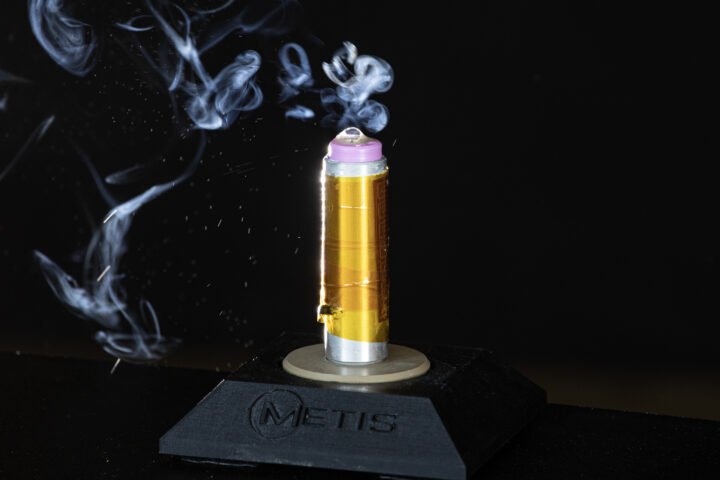
Cell Guard is a compact, CAN-based sensor that sits inside the battery pack and monitors the environment the cells live in. It measures VOCs, absolute pressure, humidity, absolute moisture content and dew point, with optional hydrogen detection and shock load measurement. In a typical EV pack it detects VOCs from off-gassing in around four seconds.
Each parameter has a job. VOC concentration and its rate of change separate early venting from later stage failure. Pressure confirms a venting event in a sealed enclosure. Hydrogen identifies later stage venting, and electrolysis caused by water ingress. Moisture and dew point expose the slower threats to pack life: seal failure, condensation and corrosion. Shock data records impacts that may have damaged cells without leaving a visible mark, so operators can decide on evidence whether a pack stays in service.
Thresholds on every parameter are set by the system integrator, and the sensor reports both threshold breaches and measured values over CAN. A wake-up function keeps the pack monitored while the vehicle is parked, which is when many battery fires begin. Cell Guard can also trigger the sequence that disconnects the pack, giving cells the chance to cool before failure propagates.
Getting the data to the right place
Detection only has value if the data reaches something that can act on it. Cell Guard is developed using ISO 26262 processes, is certified to ISO automotive standards and is used by OEMs and Tier 1s in ASIL B applications. It is deployed in more than 500 systems.
We recommend one sensor per pack, or one per 80 litres of free air volume, mounted close to the breather where vented gas will reach it first. In vehicles with several packs, such as electric buses, each sensor takes its own CAN address so the BMS can identify and isolate the affected pack immediately.
The standard is shifting
Voltage and temperature monitoring will remain the foundation of battery management. As the sole basis for safety, they are no longer enough. Regulators are moving towards requirements for early warning and evacuation time. Fleet operators want to know what happens in a depot at three in the morning. Insurers want evidence rather than assurances.
Early warning battery failure detection belongs in the baseline specification of every electrified vehicle, vessel and energy storage system, not on the options list for premium programmes. The chemistry gives the warning. Whether the system hears it is a design choice.