How a student engineering team protected a world-first vessel against the same failure that damaged an earlier design.
Some of the most demanding applications for battery monitoring technology are not found in commercial vehicle fleets or established industrial settings, but in the experimental engineering programmes pushing entirely new technology into the field for the first time. The TU Delft Hydro Motion Team’s liquid hydrogen powered race boat is exactly this kind of project, and it offers a genuinely instructive look at how Cell Guard performs when reliability cannot be assumed and every gram and every hour of development time counts.
A Student Team With a World-First Ambition
The Hydro Motion Team is a 26-strong student engineering collective based at TU Delft in the Netherlands, working out of the university’s Dream Hall alongside several other ambitious student projects. Their goal for the 2026 season is to compete at the Monaco Energy Boat Challenge in July with the world’s first foiling, liquid hydrogen powered race boat, a vessel that uses long hydrofoil struts to lift clear of the water at speed, dramatically reducing drag and reaching a cruising speed of around 40 kilometres per hour.
The team’s roots go back to 2005, when it began as the TU Delft Solar Boat Team. After winning the World Championship at Monaco in 2019 with solar technology, the team pivoted to hydrogen in 2020, won the Open Sea Class in 2023, and completed the first hydrogen powered crossing of the North Sea in 2024. The move to liquid hydrogen for the 2026 season offers three times the energy density of compressed hydrogen gas for the same volume, but introduces a fresh set of engineering challenges that come with handling cryogenic fuel at racing boat scale.
The Challenge: Monitoring Humidity Inside a Sealed Battery Casing
“When I designed the battery we used for our liquid hydrogen boat, one of the requirements was that I would be able to monitor the humidity level inside the casing. This requirement is partly due to a previous occasion where water got inside a battery casing and corroded it.” 마르틴 쿠프만, 파워트레인 엔지니어, 하이드로 모션팀
The team’s need for reliable monitoring stemmed directly from past experience. A previous battery casing had suffered water infiltration that caused significant corrosion damage, a failure mode that is far from unique to student racing teams but takes on particular significance in a marine environment, where a vessel’s electrical systems are operating in constant proximity to water.
Powertrain engineer Martijn Koopman needed a solution that could track humidity levels inside the battery enclosure to catch potential water ingress early, integrate cleanly with the team’s existing CAN bus architecture, and do all of this with minimal installation complexity given the team’s tight one-year build cycle.
The Solution: A Plug and Play Fit
“Your product was an ideal candidate for this since it was able to communicate via CAN bus and was plug and play, no further design needed.” 마르틴 쿠프만, 파워트레인 엔지니어, 하이드로 모션팀
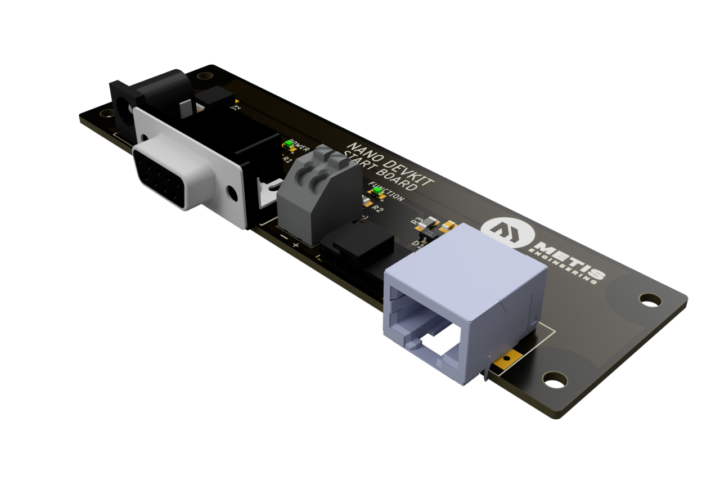
After evaluating the available options, the team selected Metis Engineering’s 셀 가드 sensor. Its combination of multi-parameter sensing and CAN native integration meant it could be added to the team’s existing systems architecture without introducing additional development overhead, a meaningful consideration for a team where every extra hour of bespoke engineering carries a real cost against a fixed build schedule.
The physical installation reflected this same pragmatic approach. Because the team’s primary focus was humidity and temperature monitoring rather than vibration analysis, Koopman simply mounted the sensor to a panel using Velcro, avoiding the need for bespoke fixings entirely.
구현 및 결과
Cell Guard was integrated directly into the team’s own data visualisation platform, giving engineers real-time access to battery condition data through a custom web interface during both bench testing and on-water operation.
“It was interesting to see the temperature and humidity rise whenever we were using the battery.” 마르틴 쿠프만, 파워트레인 엔지니어, 하이드로 모션팀
This real-time correlation between operational state and internal environmental conditions has given the team a clearer understanding of their system’s thermal dynamics, while continuous humidity monitoring provides exactly the kind of early warning the project required, guarding against the corrosion damage experienced previously. Although the accelerometer capability built into Cell Guard was not required for this phase of the project, the team noted its value for future development stages as the boat’s testing programme progresses.
“At the time, I didn’t have any need for its other functions although it will prove useful in the future.” 마르틴 쿠프만, 파워트레인 엔지니어, 하이드로 모션팀
Why This Case Study Matters Beyond Student Racing
The Hydro Motion Team’s deployment illustrates something that holds true well beyond the world of student engineering competitions: purpose-built monitoring technology can integrate cleanly into genuinely novel applications without adding development burden, provided that integration has been designed in from the outset. Whether the application is a liquid hydrogen race boat, a passenger EV, or a stationary energy storage installation, the same underlying requirement applies: reliable, easily integrated sensing that does not demand a custom engineering solution every time it meets a new use case.
As the Hydro Motion Team prepares for water testing ahead of the Monaco Energy Boat Challenge in July 2026, Cell Guard continues to provide the battery health visibility the team needs to operate a propulsion system that has never been deployed at this scale before.
Read the Full Case Study
This is a summary of a longer case study published on our website, including further detail on the vessel, the team, and the Monaco Energy Boat Challenge itself. Read the full case study here to find out more, or visit our Cell Guard product page to see if it could support your own application.